Build a Lidar Robot Tank in Python: Map & Navigate
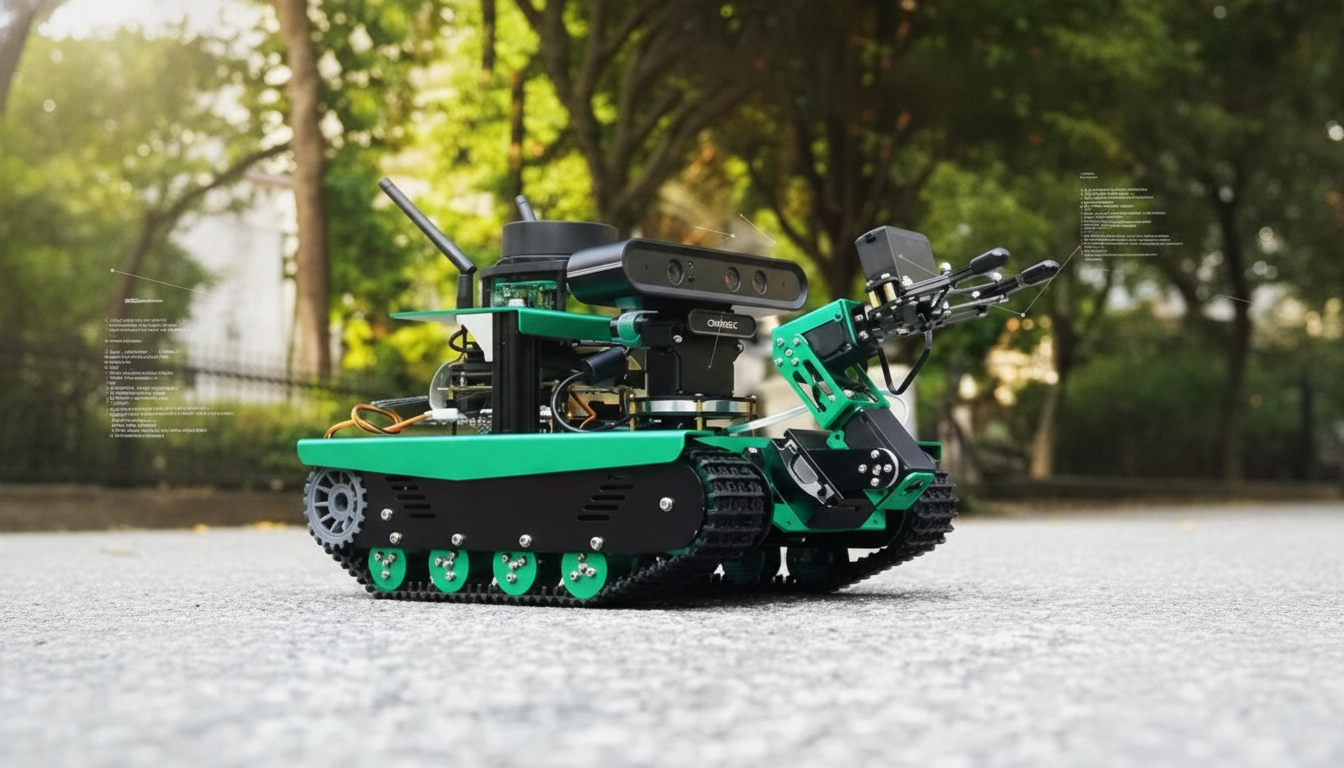
AI Vision Robot Tank Kit with Lidar & Python Programming: Build, Map, and Navigate
An AI vision robot tank kit with lidar and Python programming support is a practical way to learn how real indoor robots perceive the world, build maps, and make navigation decisions. By combining tracked mobility (for stable movement) with distance scanning and camera-based perception, this kind of platform makes it possible to run repeatable experiments—then iterate quickly as you improve calibration, control loops, and autonomy logic.
If you want a ready-to-run option, the AI Vision Robot Tank Kit with Lidar & Python Programming is an in-stock platform designed for mapping, obstacle avoidance, and vision-guided behaviors using Python workflows.
What This Robot Tank Platform Is Designed To Do
This style of robot kit is built to bridge the gap between “it moves” and “it navigates.” The key idea is that mobility, sensing, and software are designed to work as a system, so you can test autonomy behaviors without fighting basic reliability problems.
- Combine tracked mobility with sensor-driven navigation for stable indoor movement on carpet, thresholds, and uneven floors.
- Use lidar scans to estimate distance to surrounding objects and support mapping and obstacle avoidance behaviors.
- Use a camera for vision tasks such as object detection, color tracking, and target-following workflows.
- Develop behaviors in Python, from basic motion control to perception pipelines and autonomy logic.
- Support classroom labs and personal projects where repeatable experiments matter (consistent sensor inputs, predictable motion).
Core Components and How They Work Together
Robot autonomy is rarely about a single sensor. The most reliable indoor behavior comes from layering inputs: lidar for geometry, camera for semantics, and optional inertial/encoder data for smoother motion estimates.
Tracked chassis
Tracks prioritize traction and stability. That matters indoors because small slips can break the assumptions behind odometry (your robot’s estimate of how far it moved). A stable chassis makes mapping and localization more consistent across runs.
Lidar
Lidar provides a 2D “ring” of distance measurements around the robot. It’s the backbone of many indoor behaviors such as wall following, obstacle detection, and 2D mapping/SLAM, where the robot tries to build a map while estimating its position within it.
Camera / depth camera (configuration-dependent)
A camera adds capabilities lidar can’t: recognizing specific objects, tracking colors, reading markers, or triggering behaviors based on what the robot sees. If depth is available, it can help with near-field reasoning (for example, identifying a clear stopping distance in front of a target).
Compute and control stack
The compute layer runs your Python code to read sensors, make decisions, and send motor commands. Many educational and prototyping robots integrate well with robotics middleware for message passing and modular nodes; ROS documentation is a good reference for common patterns used in navigation stacks.
Power system
Battery capacity affects runtime and stability. When voltage sags, lidar units can reset and cameras may drop frames—creating “mystery” bugs that look like software problems. Consistent power is a reliability feature, not just a convenience.
Sensors and typical uses in projects
| Component | What it measures | Common project uses | Typical setup notes |
|---|---|---|---|
| Lidar | Distances around the robot in a scan | Obstacle avoidance, wall following, 2D mapping/SLAM | Needs stable mounting and correct frame orientation |
| Camera / Depth camera | Images (and depth if supported) | Object tracking, marker detection, semantic behaviors | Lighting affects results; calibrate intrinsics when possible |
| IMU (if present) | Angular velocity and acceleration | Heading stabilization, smoother odometry fusion | Sensitive to vibration; filter data for control loops |
| Encoders (if present) | Wheel/track motion increments | Dead-reckoning, speed control, odometry | Track slip can cause drift; fuse with lidar/IMU |
Software Workflow: From Python Basics to Autonomous Navigation
A good build sequence moves from “deterministic motion” to “safe motion” to “autonomous motion.” Python is well-suited for this iterative approach, especially when combined with established libraries like OpenCV for vision and standard tooling from the Python documentation.
Hands-On Projects That Fit a Tank + Lidar + Vision Stack
Setup Tips That Prevent the Most Common Failures
Who This Kit Fits Best
Product Snapshot
For a single platform that brings tracked mobility, lidar-based ranging, and Python programming together, the AI Vision Robot Tank Kit with Lidar & Python Programming is a high-end educational option designed for mapping, obstacle avoidance, and vision-guided behaviors. Best results come from a structured test area with clear walls, consistent lighting, and repeatable routes.
At-a-glance details
| Item | Detail |
|---|---|
| Name | AI Vision Robot Tank Kit with Lidar & Python Programming |
| Price | 1688.99 USD |
| Availability | In stock |
Optional Lab Add-On (In Stock)
If you need a controllable space to reduce distractions during testing—especially for vision experiments—an enclosed area can help you standardize lighting and obstacle layouts. The Living Room Outdoor Family Shelter Tent can serve as a flexible test enclosure for repeatable indoor navigation routes and controlled target-following drills.
FAQ
Does this robot kit support mapping and navigation with lidar?
Yes—lidar scans are commonly used for obstacle avoidance and 2D mapping/SLAM, and navigation typically combines mapping, localization, and path following. The exact capability depends on the included software stack and how the kit is configured and calibrated.
Is Python enough for controlling sensors and building autonomy behaviors?
Yes. Python is widely used for robotics scripting, sensor processing, and autonomy logic, especially when paired with established libraries and middleware. For heavy vision models, performance can depend on onboard compute, so many projects prototype in Python and optimize only where needed.
What kind of indoor space works best for reliable testing?
A clutter-controlled area with consistent lighting, matte surfaces, and clear walls tends to produce the most repeatable results. Start with simple routes and add obstacles gradually so you can isolate whether failures come from perception, planning, or control.











Leave a comment