152/1900 GoTo Telescope Review: Sharp Moon & Planet Views
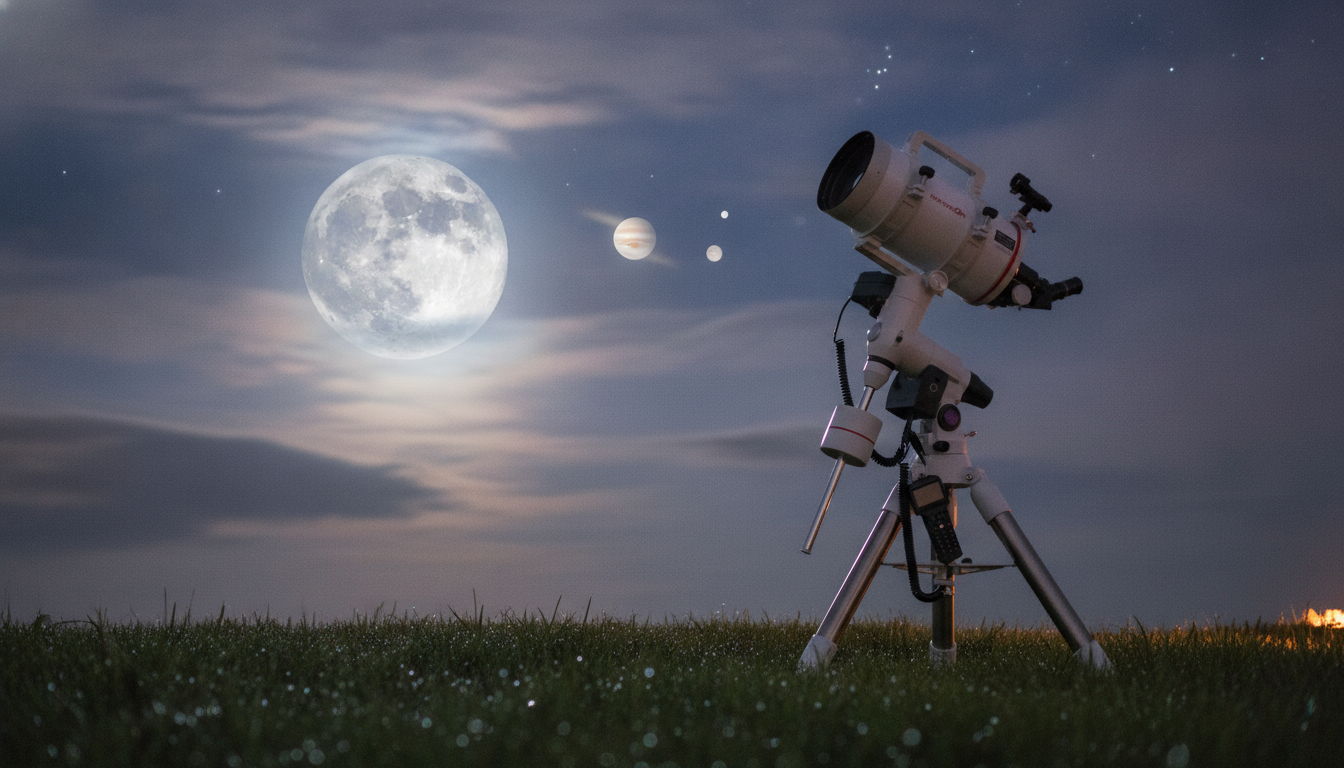
High-Definition 152/1900 Telescope with Automatic Star Search: What It’s Like to Use and Who It’s For
A 152/1900 telescope paired with automatic star search is built for observers who want crisp, high-magnification views without turning every session into a manual hunt. The “152/1900” numbers shape what you’ll see at the eyepiece, while the computerized pointing system changes how quickly you can move from the Moon to planets to brighter deep-sky favorites. Below is a practical look at what to expect in real use—especially if you’re aiming for sharp lunar detail, satisfying planetary views, and a smoother experience under suburban skies.
What the 152/1900 specification means at the eyepiece
The 152 mm aperture (about 6 inches) is the light-collecting “front end” of the system. More aperture generally means brighter views and better resolving power, which pays off most on high-contrast targets: crater edges, lunar mountain shadows, planetary banding, and close double stars. The 1900 mm focal length leans the telescope toward higher magnification with common eyepieces, but that also narrows the true field of view—so wide, sprawling objects can be harder to frame in one shot.
Long focal length designs can be extremely rewarding on planets and the Moon, but they also highlight two realities: atmospheric steadiness (“seeing”) and mechanical stability. When the air is turbulent or the mount is a bit shaky, high power makes those issues obvious. On calmer nights with a stable setup, this class of telescope can deliver crisp, contrasty views that feel “zoomed in” without needing extreme eyepiece choices.
| Spec | What it affects | What you’ll notice | Practical tip |
|---|---|---|---|
| 152 mm aperture | Light grasp & resolution | Brighter views and finer detail on the Moon/planets | Allow time for the optics to cool to ambient temperature |
| 1900 mm focal length | Magnification & field of view | Higher power with typical eyepieces; smaller sky patch visible | Use a low-power eyepiece to center targets before increasing power |
| High magnification use | Sensitivity to vibration/seeing | Image can shimmer or shake at high power | Prioritize a rigid tripod/mount and observe on calmer nights |
| Narrower field tendency | Framing large objects | Some big nebulae may not fit fully | Focus on compact objects and use wider-field eyepieces when possible |
Automatic star search: what it does (and what it doesn’t)
Automatic star search typically means a computerized hand controller (or similar interface) with a database of objects. You pick a target—Moon, Jupiter, the Ring Nebula, a Messier cluster—and the mount slews the telescope toward that object. For many observers, this is the difference between a session spent scanning and guessing versus a session spent observing.
Automation is especially helpful in light-polluted neighborhoods where fewer guide stars are visible to the naked eye, making traditional “star hopping” harder. It also helps when sharing the telescope with family or guests: you can move quickly between crowd-pleasers without long pauses.
What it doesn’t do: it doesn’t remove the need for alignment. The system must learn where it is pointing by using alignment stars, time/location entry, GPS assistance, or a leveling/north reference (depending on the design). And at very high magnification, even small tracking errors can become noticeable, so careful setup still matters.
Setup workflow for smoother nights
A stable routine is the fastest way to get consistently good results from a computerized, long-focal-length telescope.
For additional observing fundamentals and practical sky tips, the NASA Night Sky Network and Sky & Telescope’s observing basics are solid references.
What you can realistically see
High magnification isn’t automatically “better.” Many objects look their best at moderate power, where the background appears darker and the image stays steadier. If local light pollution is a constant challenge, guidance from the International Dark-Sky Association can help with practical steps and expectations.
Accessories and upgrades that make a big difference
Care, transport, and long-term reliability
Product snapshot
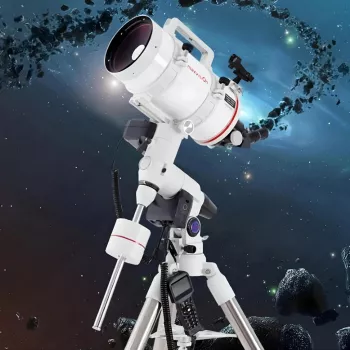
The High-Definition 152/1900 Astronomical Telescope with Automatic Star Search is positioned for observers who want higher-power viewing with the convenience of guided target acquisition. It’s best suited to planned sessions: do alignment carefully, then work through lunar features, planets, and brighter catalog objects at a comfortable pace.
- Nordic Rattan Leisure Single Sofa Chair – Solid Wood, Modern Fabric Design (for steadier, more comfortable observing)
- Living Room Outdoor Family Shelter Tent (extra comfort for longer sessions, wind break, and gear staging)
At a glance
| Item | Details |
|---|---|
| Name | High-Definition 152/1900 Astronomical Telescope with Automatic Star Search |
| Price | 3650.49 USD |
| Availability | In stock |
| Link | View product |
FAQ
Does automatic star search work without alignment?
Usually not. Most systems require an alignment routine (and correct time/location) so the mount can map the sky accurately; careful centering of alignment stars is the biggest factor in whether targets land in the eyepiece.
Is 152/1900 better for planets or deep-sky objects?
It tends to favor the Moon and planets, plus compact, brighter deep-sky targets like clusters and select nebulae. The longer focal length narrows the field of view, and truly faint galaxies still depend more on dark skies than on magnification.
What causes targets to drift out of view at high magnification?
Common causes include imperfect alignment/tracking, mount vibration, imbalance, low or unstable power to the motors, and poor atmospheric seeing. Dropping to moderate power and re-centering periodically can make the view more stable and enjoyable.














Leave a comment